Saturday, March 19, 2022

30 Days in Sydney


Which is about the longest I would ever want to stay in Sydney although I have stayed longer: once, in early 1972, after having come down from New Guinea in search of a so-called 'career job', for two months; then again in late 1972, having been sent down from New Guinea to take up a so-called 'career job', for six months; and more recently in 1985 after my return from overseas and a pretzel-shaped 'career' chasing big jobs and big money, for another six months; altogether just over a year.

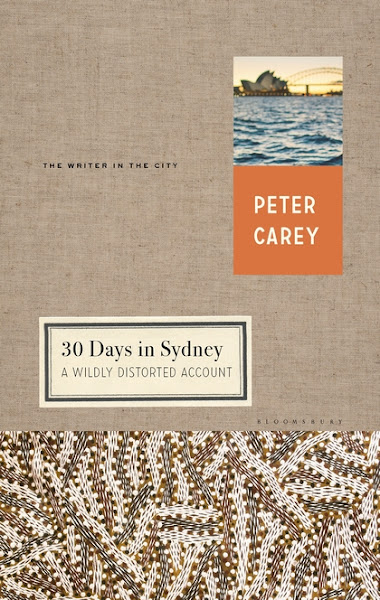
Which means I know almost nothing about Sydney and very little about my own little bailiwick, McMahons Point, which I only left to walk up the Pacific Highway to my office in Chatswood. As Peter Carey writes in his book, "If you can confidently say you know a city, you are probably talking about a town. A metropolis is, by definition, inexhaustible, and by the time I departed, thirty days later, Sydney was as unknowable to me as it had been on that clear April morning when I arrived."

And yet it was the first place I set foot in when I came off the boat in 1965. A fellow-migrant, another young German, and I ventured just far enough from the FLAVIA, tied up at Pyrmont, to explore the Rocks and to sit on the steps leading up to the Sydney Harbour Bridge. We still had some distance to go before we would finally disembark in Melbourne and be processed through the Bonegilla Migrant Centre, but we had already decided to come back to this spot every Sunday and wait for the other one to turn up. I never did, as I moved from Bonegilla to Melbourne and from Melbourne to Canberra, and I've often wondered how many Sundays my mate sat on those stairs waiting for me to turn up.

In my opinion, the only reason for living in Sydney is work, and since I no longer work, I no longer need to go to Sydney. Anyway, having made a career out of turning my back on painful memories, I'm not about to relive them. Peter Carey's wildly distorted account is as close as it gets.


Friday, March 18, 2022

"Your coming here would give me a new lease on life"

The main street of Mount Perry, circa 1956, when it was still in its heydays


It is possible, I suppose, to construct hypothetical circumstances in which you would be pleased to find yourself, at the end of a long day, in Mount Perry, Queensland - perhaps something to do with rising sea levels that left it as the only place on earth not under water, or maybe some disfiguring universal contagion from which it alone remained unscathed. In the normal course of events, however, it is unlikely that you would find yourself standing on its lonely main street at six thirty on a warm summer's evening gazing about you in an appreciative manner and thinking: 'Well, thank goodness I'm here!'"

So wrote Bill Bryson in his book "Bill Bryson Down Under" in chapter 12 about Macksville, New South Wales. I took the liberty of quoting from it, only substituting Mount Perry for Macksville, both of which I know, Macksville because an old accountant-friend from my days in New Guinea had opened an office there, doing little more than helping cow cockies fill out unemployment claim forms, and Mount Perry because my best friend, also from my New Guinea days, had settled there sometime in the early 1980s when I was still working in Athens in Greece and started receiving letters from him postmarked "Mount Perry Qld 4671".

That was years before the internet, and I had no way of knowing where Mount Perry was or what it looked like. That eye-opening revelation was left until mid-1985 after I had returned to Australia and, unable to find work in Townsville in Far North Queensland, I moved down to Sydney and visited Mount Perry on my way south. By that time the last traces of some former mining boom had disappeared, the picture show had been closed for years, the local mechanic had just moved to Gin Gin, the only shop in town hardly ever saw a customer, and the post office which had postmarked all those letters seemed on the verge of closing. In fact, my friend who waited for me in town to guide me to his lonely plot of land, had parked in front of it, and his was the only car in the main street.

He'd sent me this photo while I was still working in Greece and after he'd just bought himself this small prefab on a five-acre plot. It was the sort of place where you went when you had little money and life hadn't been too good to you and you needed time to lick your wounds.


Noel's prefab on his five-acre plot. As he wrote on the back,
"It's as isolated as it looks, but plenty of crows and wallabies for company"


Following my return to Australia due to a misdiagnosed case of home-sickness, life hadn't been too good to me either, and I was also licking my wounds in Sydney when my best friend invited me to join him at Mt Perry. "Your coming here would give me a new lease on life" he wrote - words from a quiet, lonely man who had sought a refuge and become stranded. He had stayed away too long, and everyone had forgotten him. It was the nearest he'd ever come to admitting that his own home-coming after a lifetime in New Guinea hadn't worked out the way he'd hoped, and he was feeling lonely and in need of like-minded company.

My friend's cri de coeur - for that is what it was - never quite registered because, while I'd experienced my own bouts of loneliness which had always been cut short by the excitement of forever chasing work around the world, I still had another twenty-five years of work ahead of me.

As so often happens, the story had a happy ending for both of us: I left Sydney for Canberra where I was able to establish my own practice, and Noel could sell his isolated plot with "plenty of crows and wallabies for company" and resettle on the edge of Childers, within walking distance of shops and pubs and medical facilities, where I revisited him in 1990 to spend our last Christmas together before he passed away in 1995.


Thursday, February 17, 2022

When dream meets reality


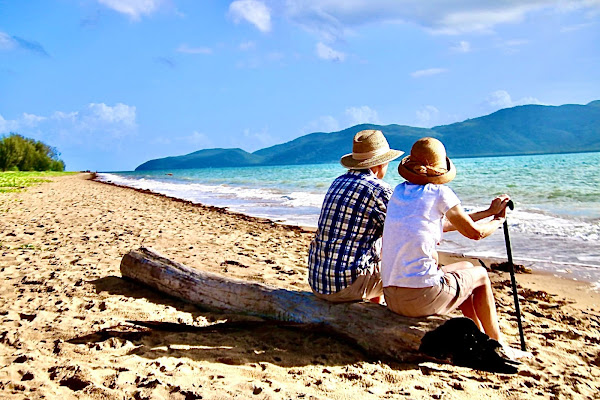
Someone - not me! - sitting on Pallarenda Beach looking towards Magnetic Island


Perhaps it was a mental image such as this that made me buy a block of land in Picnic Bay on Magnetic Island in 1979 and a couple of years later an old beachshack on Pallarenda Beach.

We all need a dream, and the dream of one day living there gave me a sense of hope and home as I continued my peripatetic, some might say pathetic lifestyle, moving from place to place and country to country.

I once met an Englishman in Honiara in the then British Solomon Islands Protectorate who spent his evenings drinking gin & tonics in front of a fake fireplace with a huge painting of London's Tower Bridge above it.

In Maugham's "On a Chinese Screen" collection of 1922, there's a short story called "Mirage", which tells of a character from England called Grosely who has spent most of his working life in China. We're given in the first pages much background detail concerning his early days as a medical student, and what brought him to the Orient in the first place.

But the story really only picks up when, after years of very difficult saving and hard work, Grosely is able to travel back to the England he has adored, with the money he has accumulated. What happens when he eventually arrives, however, is perhaps not all that surprising.

"It was different from how he remembered it, there was much more traffic and he felt confused and a little at sea. He went to the Criterion and found there was no longer a bar where he had been used to lounge and drink. There was a restaurant in Leicester Square where he had been in the habit of dining when he was in funds, but he could not find it; he supposed it had been torn down."

What he does next is really quite interesting. He leaves England, his memories and perhaps part of his Self, for China. En route, he visits places like Singapore and Colombo. But at the last stopping place before China proper - Haiphong - he remains. He’s only supposed to go ashore for forty-eight hours, but he stays, because for this character at least a sense of self - partial and fluid though it may be - is so immediately tied to place: "I’ve never been so happy in my life. I often think I'll go on to Shanghai some day, but I don't suppose I ever shall. And God knows, I never want to see England again", he remarks to the narrator.

Looking at life through the wreaths of opium smoke that he exhales several times a day, Grosely represents the partially disorientated traveller who has settled for flux rather than fixity. Positioned between east and west, undecided where home actually is, Grosely seems to find the in-between existence not only agreeable, but a sort of solution.

"I knew that on the threshold of China his courage had failed him. England had been such a terrible disappointment that now he was afraid to put China to the test too. If that failed him he had nothing. For years England had been like a mirage in the desert. But when he had yielded to the attraction, those shining pools and the palm trees and the green grass were nothing but the rolling sandy dunes. He had China, and so long as he never saw it again he kept it."

When dream meets reality it sometimes becomes a nightmare, and so it was with my premature homecoming in 1985. I felt like one of those expat characters in a W. Somerset Maugham story who, when finally washed up on their home shores, can often be found peering into an empty glass while wishing to be somewhere else. Maybe I, too, should have stayed forever abroad and dreamt of home from a safe distance.

I sold the block of land on the island and that beachshack in the late '90s for little more than what I had paid for them which didn't matter as by then they'd served their purpose as my London Tower Bridge painting.